
Decades-retained original hardware
That gap matters. Houses from this era in Rose Hill often kept their original tracks, drums, and end bearings even after a spring failed once or twice, because nobody thought to swap hardware that still turned.
Rose Hill, Chantilly
Rose Hill homes date to 1967 on average, older than most of the service area. That means original tracks and drums on torsion hardware nobody stocks fresh anymore.
On the truck
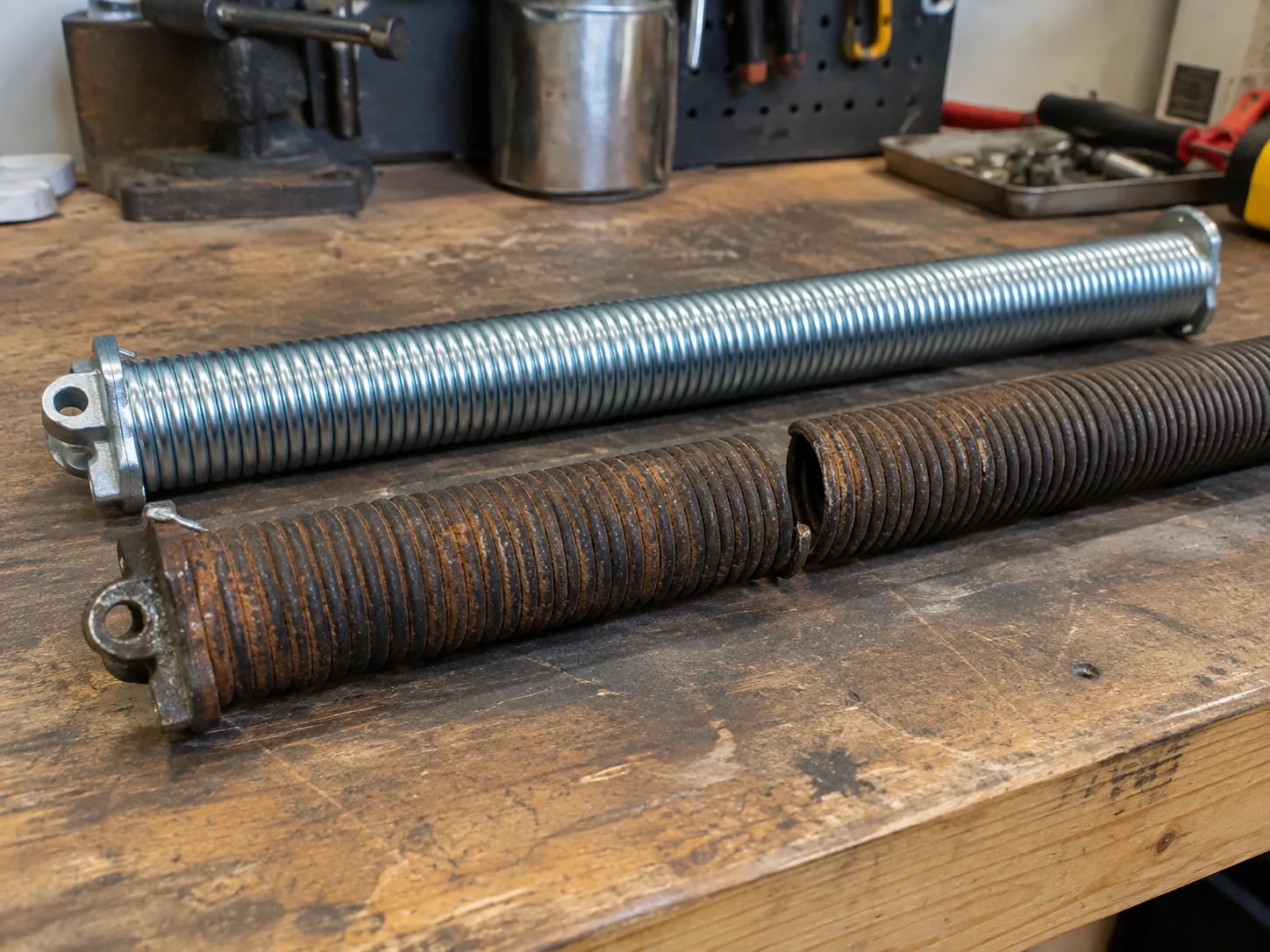
For a Rose Hill call, the truck carries torsion springs sized for the door widths that showed up on homes built around 1967 - a decade or more before the median build year across the rest of the service area, which sits closer to 1981.
That gap matters. Houses from this era in Rose Hill often kept their original tracks, drums, and end bearings even after a spring failed once or twice, because nobody thought to swap hardware that still turned.
We carry torsion springs in a spread of wire sizes and inside diameters to match older drum setups, plus standard safety cables, since a lot of these doors never had one installed to begin with. We also bring extension spring sets for the smaller number of doors on that older track style, in case the door wasn't converted to torsion at some point in the last five decades.
What we don't carry on every run is a replacement drum or track section sized for a door nobody makes anymore - if the drum is pitted or the track is bent past true, that's a second trip once we know the exact door.
DIY or pro
A broken torsion spring on a door built when Rose Hill's typical house went up is not a Saturday project. The spring is wound under enough tension to break a wrist or worse, and on a door this old, the winding cones and set screws have usually corroded or loosened over decades of temperature swings. Extension springs are a little more forgiving to look at, but the safety cables that should run through them are often missing on original installs, and that's the part that turns a snapped spring into a swinging door section. If you're comfortable disconnecting the opener and manually lifting the door to check balance, that's a fair diagnostic step. Winding or unwinding the spring itself is where we'd tell you to stop and call. We say that knowing it costs us nothing to say it - it's just the honest line on this one.
Pricing
We don't quote a number sight unseen, especially on a door this age where the spring is rarely the only worn part.
What we can say is that Rose Hill's median household income runs about $160,426, roughly $11,000 above the $149,344 median across the wider service area, and in practice that means more Rose Hill owners choose to replace both springs and the worn drums at the same time rather than patch one spring and wait for the second to go.
That's a homeowner's call, not ours to push. If the door is original to a 1967 build and the track is still true, a spring swap alone can be the right, cheaper move. If the drums are grooved or the shaft is bent, doing the spring by itself just buys you another service call in a year or two.

Local causes
The service area sits in a cold-climate band with real seasonal swings, and torsion springs lose tension gradually as the steel cycles through repeated heating and cooling over the years. On a door installed around 1967, that spring has been through roughly five decades of those cycles - most springs are rated for a fraction of that many cold-to-warm swings. Rose Hill's stock, being older than the roughly 126,618-household service area's median, tends to show fatigue failures rather than the sudden-impact breaks we see on newer doors with lighter, higher-cycle springs. Garage temperature matters more than people think - an unheated garage on an older Rose Hill house sees a wider daily swing than a newer, better-sealed one nearby, and that swing is what tires the steel.
Warning signs
If the door won't budge past a few inches, or the opener strains and reverses, that's usually a torsion spring gone slack rather than an opener problem - a common misdiagnosis on older doors where owners assume the motor is failing. A visible gap in the coil, or one side of the spring hanging lower than the other, is a break waiting to happen rather than one that already has. On the older extension-spring doors still found on some Rose Hill houses, a loud bang followed by the door dropping fast on one side is the spring letting go, and if there's no safety cable, that spring can whip. Either way, don't run the opener again once you see these signs - it strains the opener motor against dead weight it wasn't built to lift.
Watch-outs
The job goes sideways when the spring gets replaced but the drum or shaft underneath it doesn't get checked, and on a door original to a 1967 build, that shaft has had a long time to develop rust pitting or a slight bend.
A new spring on a bent shaft wears unevenly and can fail again within a year, which reads to the owner like bad parts rather than what it actually is.
It also goes sideways when someone matches the new spring to the old one by eye instead of by door weight and drum size - a mismatch either strains the opener or leaves the door too light, so it doesn't stay put when you lift it by hand.
We travel the 19 miles out from Chantilly for these calls, so getting the diagnosis right the first trip matters more here than it might closer to the shop.
Questions
If the house is close to the 1967 median build year for the area and the spring hasn't been replaced, it's decades past its rated cycle life. Most torsion springs are built for far fewer heating-and-cooling cycles than a door this age has already seen, so age alone is often reason enough to replace rather than patch.
No. We run out of Chantilly, about 19 miles from Rose Hill, and bring a stocked truck sized for the job once we know the door. There's no local branch or drop point here - it's a dispatched call, same as the rest of the towns we cover.
On a door this old, we usually recommend it, since the second spring has seen the identical years of wear and is close behind. It's not required - a single spring swap is a valid, cheaper fix if the other spring still tests firm - but on original 1967-era hardware, both springs are usually near the same point in their life.
Usually, yes, especially on older doors, but not always. A dropped door with a loud bang and one side hanging low points to a spring failure. A rattling bang without the door dropping can be a loose track bracket instead. Either way, don't force the opener until it's checked.
Explore more
Ready when you are
Chantilly Garage Door Pros repairs and installs garage doors, springs and openers in Chantilly, VA and the surrounding area.